How to Stop Leads from Falling Through the Cracks (Complete Guide)
⚡ Quick Answer
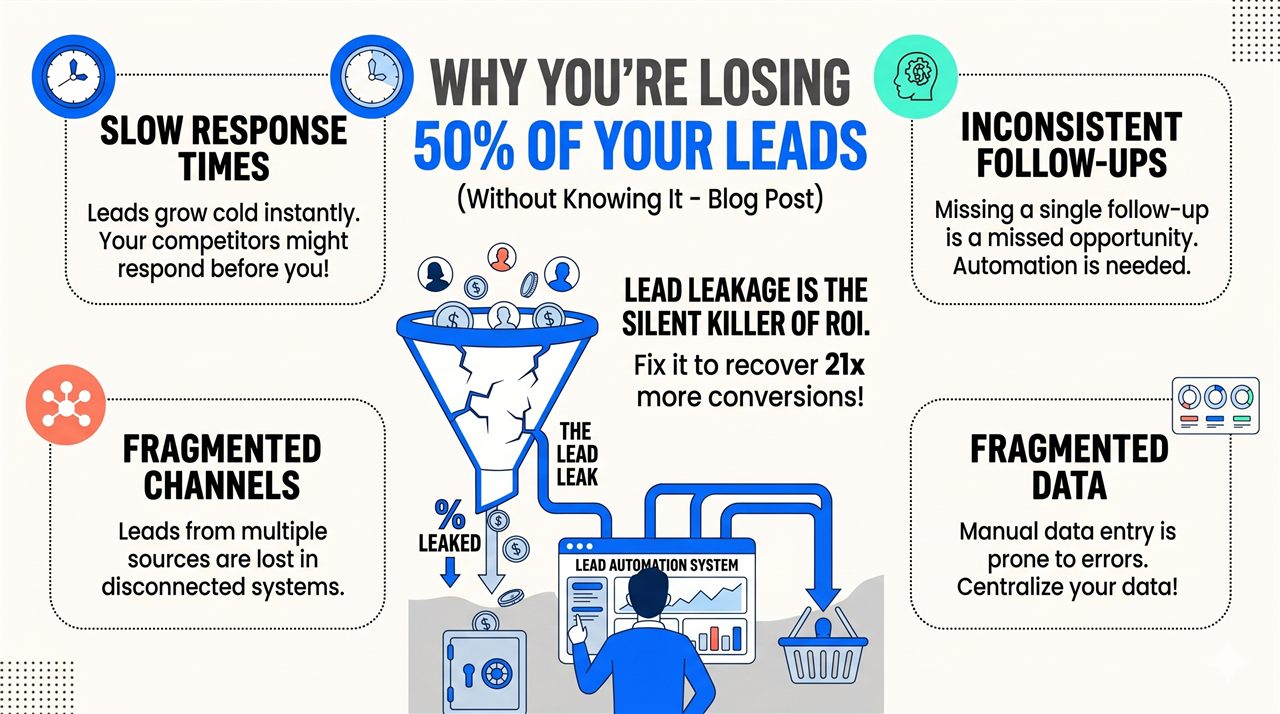
Most businesses lose 40–60% of their leads because they rely on manual processes that break down under workload, distraction, and human forgetfulness. The fix is a systematic, automated lead capture and follow-up system that guarantees 100% of leads receive timely responses — regardless of how busy your team is.
You're spending money on ads. People are enquiring. But somehow, at the end of the month, the revenue doesn't reflect the number of leads you received. Where did they all go?
This is the "leaky bucket" problem — one of the most financially damaging issues for Indian SMBs, yet one of the easiest to solve with the right system. Before you spend another rupee on generating more leads, you need to fix the process that's letting existing leads leak out.
Why Leads Fall Through the Cracks: The 6 Root Causes
Understanding why leads get lost is the first step to preventing it. Here are the six most common causes we see when auditing businesses:
1. No Centralised Lead Capture System
Leads come from Facebook, Google, website forms, WhatsApp, phone calls, referrals, and walk-ins. Each goes to a different place — someone's email, someone's WhatsApp, a notebook. No single system captures everything. Leads fall through simply because they were never recorded in one place.
2. Slow Initial Response
When no automated system exists, leads sit in inboxes for hours. By the time someone responds, the prospect's interest has cooled and they've spoken to a competitor. Research shows that 35-50% of deals go to the vendor that responds first. See our lead response time guide for the full data.
3. Over-Reliance on Human Memory for Follow-Ups
"I'll call them tomorrow" is the most expensive phrase in sales. Humans forget. They get busy. They prioritise warm leads and neglect colder ones. A lead that said "maybe next month" in week 1 gets forgotten entirely by week 3 — even though that was a qualified prospect who just needed more time.
4. No Nurture System for Long-Term Leads
In high-value purchases (real estate, insurance, premium services), prospects often need 3–6 months before they're ready to buy. Without an automated nurture sequence, these leads simply disappear. With a good system, these "slow burn" leads are automatically nurtured with helpful content and gentle check-ins until they're ready to convert.
5. Disorganised CRM (or No CRM at All)
When lead data is scattered across Excel sheets, WhatsApp, email, and paper notebooks, it's impossible to know who needs a follow-up, who was last contacted when, and what stage each prospect is at. Organisation creates accountability. Chaos creates lost leads.
6. No Lead Handoff Process
In teams, when a lead comes in and "everyone thinks someone else is handling it," no one does. Without a clear automated assignment process that assigns each lead to a specific person with a notification and deadline, team leads invariably fall through.
The Real Cost of Lost Leads
Let's quantify this. If your business gets 100 leads per month and your average deal value is ₹30,000:
- At 10% conversion rate: 10 deals = ₹3 lakh/month
- If you're losing 40% of leads to poor follow-up, you actually have 60 leads being properly worked = 6 deals
- The 4 deals you're losing = ₹1.2 lakh lost per month = ₹14.4 lakh per year in preventable revenue loss
That's the cost of not having a proper lead management system — just from the follow-up gap, before considering response time improvements.
The Complete Framework to Stop Leads Falling Through
Here's the systematic approach we implement for clients at LeadAutomation.net:
Step 1: Centralise All Lead Sources
Every single lead source — Facebook ads, Google ads, website forms, WhatsApp Business, landing pages, phone calls — needs to flow into one CRM system. This is non-negotiable. You can't follow up what you haven't captured.
Use integrations (webhooks, Zapier, or native connections) to connect each source to your CRM. Every new lead gets a record created automatically with their name, phone, email, source, and enquiry details — without any manual effort.
Step 2: Automate the Instant Response
The moment a lead is captured, trigger an automatic response sequence:
- WhatsApp message within 5 seconds acknowledging the enquiry
- Email with detailed information about your service
- Internal notification to the assigned sales rep
This guarantees no lead ever waits more than a minute for initial contact, regardless of what your team is doing.
Step 3: Build Structured Follow-Up Sequences
Not every lead converts on the first contact. Build automated sequences that follow up systematically:
- Day 1 (immediate): Welcome message + information
- Day 2: Value-added follow-up ("Here's a case study relevant to you")
- Day 5: Check-in message ("Did you get a chance to review?")
- Day 10: Different angle ("Many businesses like yours face X problem...")
- Day 21: Last attempt ("We're here whenever you're ready")
- Day 60+: Long-term nurture (monthly value email)
The automation pauses the sequence the moment a lead responds and notifies your sales team to take over. If they don't respond, the sequence continues running — ensuring every lead gets persistent, professional follow-up without your team lifting a finger.
Step 4: Implement Lead Scoring and Priority
Not all leads are equal. Automate lead scoring so your team knows who to call first:
- Leads who opened your email get +10 points
- Leads who clicked a link get +20 points
- Leads from high-intent search terms get +30 points
- Leads who visited your pricing page get +40 points
High-scoring leads get immediate priority flags. Your sales team focuses on the hottest prospects first — not whoever happened to fill a form most recently.
Step 5: Create a Dead-Lead Reactivation Campaign
Your existing database of "dead" leads is a goldmine. These are people who were interested enough to enquire but didn't convert for some reason. A 3-touch reactivation campaign to your dead leads typically converts 5–10% — all with zero new ad spend.
Choosing the Right CRM for Lead Management
The CRM is the foundation of your lead management system. For Indian SMBs, here are the top options:
| CRM | Best For | Starting Price | India-Friendly |
|---|---|---|---|
| GoHighLevel | SMBs wanting complete automation | ₹6,000/month | ✅ Excellent |
| Zoho CRM | Cost-conscious businesses | ₹800/user/month | ✅ Very good |
| HubSpot | Content-heavy marketing teams | Free (basic) | ⚠️ Limited India features |
| Salesforce | Large enterprises | ₹5,500/user/month | ✅ Good, expensive |
For most Indian SMBs, GoHighLevel (which we build on at LeadAutomation.net) offers the best combination of features, WhatsApp integration, and automation capabilities. See our detailed CRM comparison guide for more.
How to Measure Your Lead Leakage
You can't fix what you don't measure. Track these four metrics monthly:
- Lead capture rate: What % of your enquiries are actually recorded in your CRM?
- Contact rate: What % of captured leads receive any follow-up within 24 hours?
- Follow-up completion rate: What % of leads go through your full follow-up sequence?
- Lead-to-opportunity conversion: What % of leads become active sales opportunities?
If your contact rate is below 80%, your follow-up completion rate is below 70%, or your lead-to-opportunity conversion is below 15–20%, you have significant lead leakage to fix.
5 Quick Wins You Can Implement This Week
- Set up a WhatsApp Business API account and create one automated welcome message that goes to every new enquiry
- Audit your lead sources — list every place leads currently come from and identify which ones aren't captured automatically
- Create a simple CRM — even a properly structured Google Sheet with columns for Name, Phone, Source, Date, Status, and Follow-up Date is better than scattered notes
- Set a phone alarm for follow-ups — until you have automation, set daily alarms to check your lead list and make follow-up calls
- Test your own lead form — submit a test enquiry right now and measure exactly how long it takes for your business to respond
Frequently Asked Questions