Why You're Losing 50% of Your Leads Without Knowing It
⚡ Quick Answer
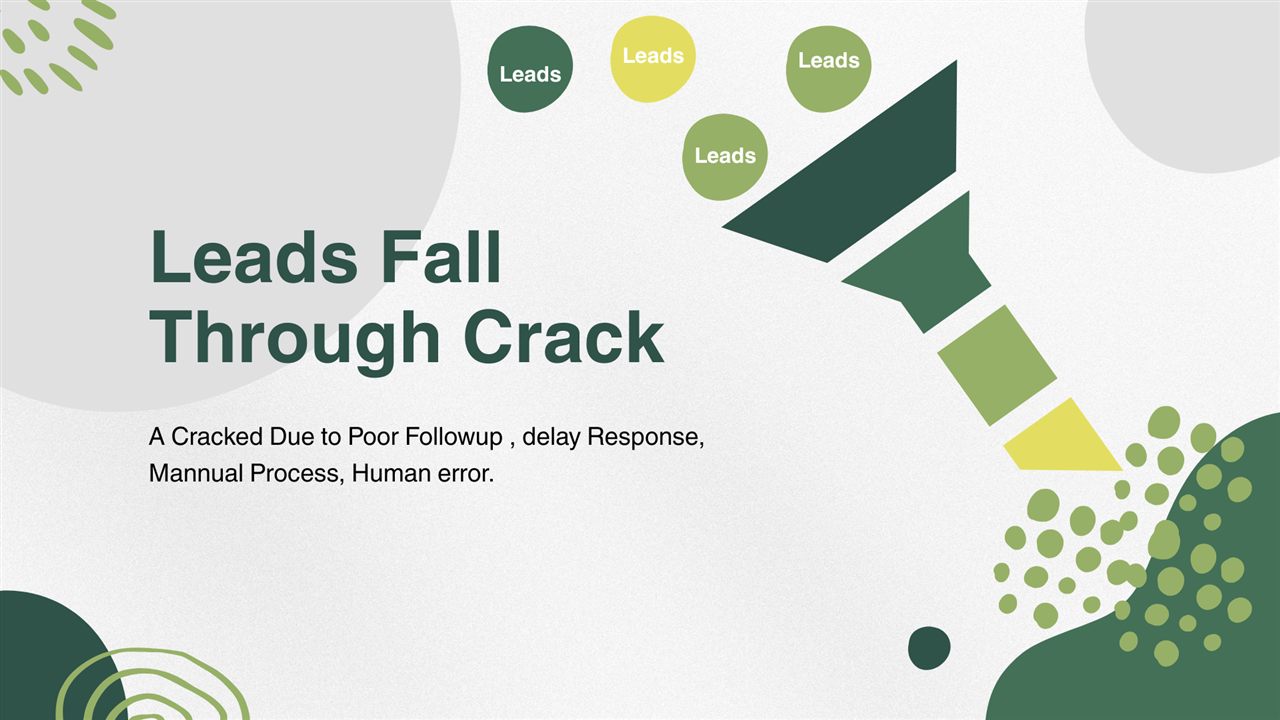
Lead leakage is the silent killer of marketing ROI. Most Indian businesses lose 40–60% of their leads before they even connect with them due to slow response times, fragmented channels, and inconsistent follow-ups. Fixing your lead management system with automation can recover 21x more conversions and transform your revenue without increasing ad spend.
The Invisible Leak Costing You Real Money
Let's do the math that most business owners never do. Say you're generating 100 leads per month from your Facebook ads and Google listing. Your average sale is ₹25,000. Your close rate when you actually connect with a lead is 15%.
If everything worked perfectly and you reached every lead and followed up consistently, you'd close 15 deals per month = ₹3,75,000 in revenue.
But what if you're losing half your leads before you even connect with them? You'd close 7-8 deals = ₹1,87,500 in revenue.
That's ₹1,87,500 per month — ₹22.5 lakh per year — evaporating from your business. Not from bad marketing. Not from bad selling. From a broken system between the two.
This is lead leakage. And it's happening in your business right now, quietly, every single day.
The 5 Ways You're Losing Leads (Ranked by Impact)
Leak #1: Slow Response — The Speed Drain
When someone submits an inquiry, they are at the peak of their interest. That peak lasts about 5-10 minutes. After that, one of three things happens: they move on to other tasks, they submit an inquiry to a competitor, or they simply forget they reached out.
MIT research found that a lead contacted within 5 minutes is 21x more likely to convert than a lead contacted 30 minutes later. Not 21% better. 21 times better. Yet the average response time for Indian SMBs is 4-8 hours.
If you have 100 leads per month and your average response time is 4 hours, you're effectively burning most of those leads before your team even picks up the phone.
How you're losing leads here: After-hours forms that nobody sees until morning. WhatsApp messages that get buried under other chats. Phone calls made during lunch or after the team clocks out. Even a 30-minute delay during business hours dramatically reduces conversion.
The fix: Instant automated response via WhatsApp the moment any inquiry comes in — 24/7, including weekends and holidays.
Leak #2: The Follow-Up Desert — Giving Up Too Early
Research across industries consistently shows that 80% of sales require between 5 and 12 touchpoints to close. Yet in a survey of Indian SMB sales processes, the median number of follow-up attempts per lead was 2.3 — then the lead was abandoned.
The math is devastating: you're doing 2 attempts when you need 8-10. You're catching roughly 20-30% of the leads that could be caught. The other 70-80% simply never hear from you again after you made two attempts and moved on.
How you're losing leads here: You call twice, don't reach anyone, and mark the lead as dead. The lead wasn't dead — they were at work, in a meeting, with their kids, driving. They were going to pick up on attempt #4. They never got attempt #4.
The fix: Automated follow-up sequences that run for 14-21 days across multiple channels (WhatsApp, email, call tasks) without requiring anyone to remember to reach out.
Leak #3: Channel Fragmentation — The Scattered Mess
You have leads coming in from Facebook. And Instagram DMs. And WhatsApp. And your website form. And Just Dial. And referrals who message your personal number. And Google calls. And walk-in inquiries logged in a notebook.
Each channel is managed differently. Some are checked hourly, some once a day, some whenever someone remembers. Some get follow-up, some don't. Some get tracked, most don't.
The leads falling into the cracks between channels — the Facebook lead that nobody imported into the spreadsheet, the Instagram DM that got buried, the referral whose number was saved in the sales rep's personal phone and left when she quit — these represent a significant portion of your leak.
How you're losing leads here: Fragmentation means no unified view, no consistent process, and massive opportunity for human error. A lead only needs to fall through the cracks once to be permanently lost.
The fix: All lead sources feeding into one CRM automatically, regardless of where the lead came from.
Leak #4: The Interest Window — Striking When Cold Instead of Hot
Some leads don't convert immediately not because they're not interested — but because your timing is off. They reached out when they were beginning to explore. By the time you follow up (days or weeks later), they either forget their original context or have moved further along in their research and are now comparing vendors.
The window when a lead is most likely to convert is actually quite specific: it's the first 24-48 hours after initial inquiry, and then again around 7-10 days in when decision pressure builds.
How you're losing leads here: Your follow-ups are happening on your schedule, not the lead's interest curve. You call on Day 3 when the optimal window was Day 1. You stop following up on Day 5 when the second interest peak hits on Day 8.
The fix: Automated sequences timed to align with typical buyer decision timelines, not based on when someone remembers to call.
Leak #5: The Cold Lead Graveyard — Ignoring Past Leads
How many leads do you have from 3, 6, or 12 months ago that you've completely stopped contacting? Hundreds? Thousands?
Most of them aren't dead. They just weren't ready when you were pursuing them. Perhaps their budget wasn't approved yet. Perhaps they were evaluating multiple options. Perhaps life got in the way. Studies show that 20-30% of leads that don't convert immediately will eventually buy from someone within 6-12 months.
The question is: will they buy from you, or from the competitor who kept showing up in their inbox while you forgot they existed?
How you're losing leads here: Once a lead doesn't convert after your initial follow-up period, they effectively cease to exist in your process. You never contact them again unless they reach back out (which most won't bother doing).
The fix: Long-term nurture sequences that keep past leads warm with monthly value-add content, so when they're ready to buy, you're the first business they think of.
Calculate Your Lead Leak Right Now
Use this formula to quantify what your current leakage is costing you:
Lead Leakage Calculator
Step 1: Monthly leads generated: ___
Step 2: Estimated leak percentage (most businesses: 40-60%): ___
Step 3: Leaked leads = Step 1 × Step 2 / 100
Step 4: Your close rate on leads you actually connect with: ___ %
Step 5: Potential missed sales = Step 3 × Step 4 / 100
Step 6: Average deal value: ₹___
Monthly revenue leak = Step 5 × Step 6
For most businesses, this number is 2-5x more than their entire marketing budget.
For a business generating 150 leads/month, leaking 50%, with a 12% close rate and ₹40,000 average deal value: 75 leaked leads × 12% × ₹40,000 = ₹3,60,000 per month in lost revenue. That's ₹43.2 lakh per year.
Real Audit: What We Found in a Mumbai HR Consultancy
A Mumbai-based HR consultancy was generating 80-90 leads per month from LinkedIn ads, website forms, and referrals. They had a team of 4 consultants handling sales alongside their delivery work. They felt their marketing wasn't working — revenue had plateaued despite spending more on ads.
What the Audit Revealed
- Average first response time: 9.3 hours (all leads during business hours; after-hours leads waited until morning)
- Average follow-up attempts per lead: 2.1 before abandonment
- Channel fragmentation: Leads coming from 5 sources, tracked in 3 different spreadsheets, with no central view
- Past lead follow-up: Zero — no activity on any lead older than 3 weeks
- Estimated lead leakage: 55% of all leads received zero adequate follow-up
- Estimated monthly revenue leak: ₹2.8 lakh based on their deal values and close rates
What Changed and What the Results Were
Over 8 weeks, the consultancy implemented: CRM consolidation (all 5 sources feeding one system), instant response automation via WhatsApp, a 21-day follow-up sequence, and a monthly re-engagement campaign for their 800+ person backlog of old leads.
Results after 90 days:
- First response time: average 4 minutes (down from 9.3 hours)
- Lead leakage rate: dropped from 55% to 18%
- Monthly revenue: increased by ₹2.1 lakh (from same lead volume, no change in marketing spend)
- Backlog re-engagement campaign: generated 6 new clients from leads that were 4-9 months old
The conclusion: their marketing wasn't broken. Their lead management was. Fixing the system — not the ads — fixed the revenue.
How to Fix Your Lead Leak: Priority Order
Based on impact and ease of implementation, here's the sequence we recommend for fixing lead leakage:
- Immediate (Day 1-3): Set up instant WhatsApp response for all new leads. This alone captures the leads currently being lost in the first 5-minute window.
- Short term (Week 1-2): Consolidate all lead sources into one CRM. Eliminate the channel fragmentation that creates invisible black holes.
- Short term (Week 2-3): Build and activate a 14-21 day automated follow-up sequence. This addresses the "giving up too early" problem.
- Medium term (Month 1-2): Set up a monthly nurture campaign for your existing backlog of old leads. Activate the cold lead graveyard.
- Ongoing: Review your funnel metrics monthly. Track where in the sequence leads are dropping off and optimize accordingly.
Find Out Exactly How Much You're Leaking
Book a free 30-minute lead audit. We'll analyze your current process and calculate your specific revenue leak number — no guesswork, actual data.
Book Free Lead AuditFrequently Asked Questions
Look for these signals: marketing spend is increasing but revenue isn't growing proportionally; you're getting inquiries but not enough conversions; leads you spoke with once never hear from you again; you have no clear record of how many leads came in last month versus how many converted. Any of these suggests significant lead leakage that's likely costing you 40-60% of potential revenue.
Industry data consistently shows that 40-60% of leads generated by Indian SMBs never convert — not because the prospect wasn't interested, but because of system failures: slow response, inconsistent follow-up, no lead tracking, or being forgotten. Many businesses with manual processes lose far more than 50%.
It's almost always a systems problem, not a marketing or sales problem. The leads are interested enough to inquire. The sales team is capable enough to close. The breakdown is in the middle — the hand-off, the response time, the follow-up consistency. This is exactly what automation addresses, without needing to change your marketing strategy or hire better salespeople.
The biggest wins come fastest. Instant response automation can be set up in a day and immediately improves the first 10-minute conversion window. Automated follow-up sequences take 1-2 weeks to configure and show results within the first full cycle. Most businesses see measurable improvement within 30 days — specifically in the form of more leads responding and moving forward.
Calculate it: (monthly leads × leak percentage as decimal) × close rate × average deal value. For example, 100 leads/month × 0.50 leak × 0.15 close rate × ₹30,000 deal value = ₹2,25,000 in monthly lost revenue. For most businesses, this number is larger than their entire marketing budget — which means fixing leakage has better ROI than spending more on ads.
No — in fact, the opposite is often true. Automation handles the first response, qualification, and initial follow-up. Your human team only gets involved when leads are warm and responsive. The same team can handle significantly more qualified leads after automation because they're not wasting time on manual tasks and cold outreach.
That's expected and fine. Not every lead converts — the goal isn't 100% conversion. The goal is ensuring that every lead that COULD have converted, DID convert. Lead scoring helps identify the genuinely uninterested early so you don't over-invest in them. Automation ensures you give every lead sufficient opportunities to engage without wasting human time on cold outreach.
Directly and dramatically. If you spend ₹50,000 on ads to generate 100 leads, your cost per lead is ₹500. If you convert 5 of those 100 leads (5%), your cost per acquisition is ₹10,000. But if you fix your leakage and convert 12 of those 100 leads (12%), your cost per acquisition drops to ₹4,167 — from the same ad spend. Fixing leakage makes your existing marketing 2-3x more efficient.
Yes, especially at lower lead volumes. When you have fewer leads, each one is proportionally more valuable — and each lost lead hurts more. With 35 leads per month and a 50% leak rate, you're losing 17-18 leads. If even 3-4 of those would have converted at your average deal value, that's potentially ₹60,000-1,20,000 per month in lost revenue from a small volume business.
Yes — we offer a free lead audit that analyzes your current process and identifies specific leakage points. We look at response time data, follow-up patterns, channel consolidation, and historical conversion rates to pinpoint where your biggest leak is. This way, you know exactly what to fix first for maximum impact.